Oct. 9, 2009 UT LCROSS Impact Imaging
Preliminary Results
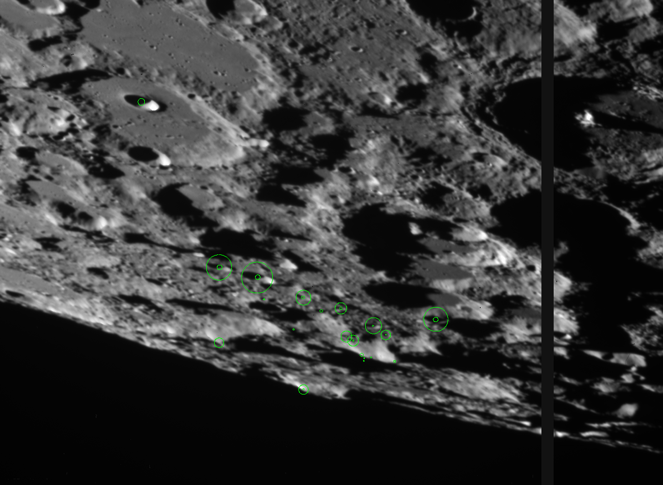
Palomar AO image of Cabeus crater 10s after Centaur impact: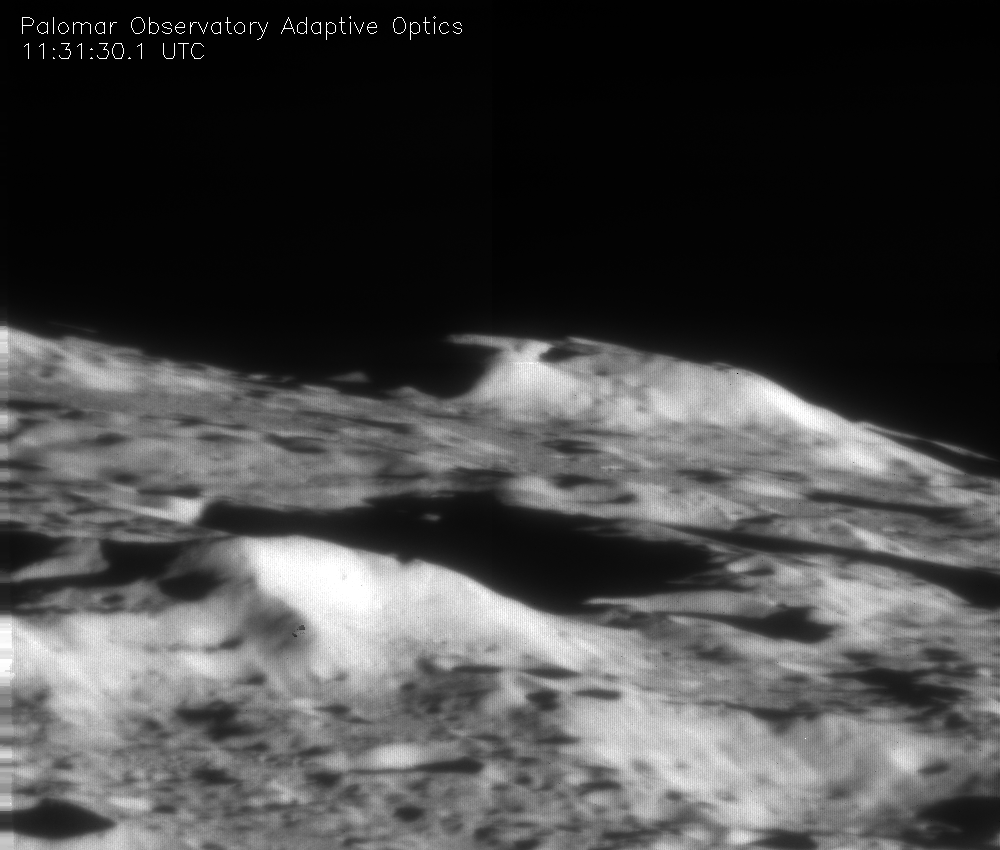
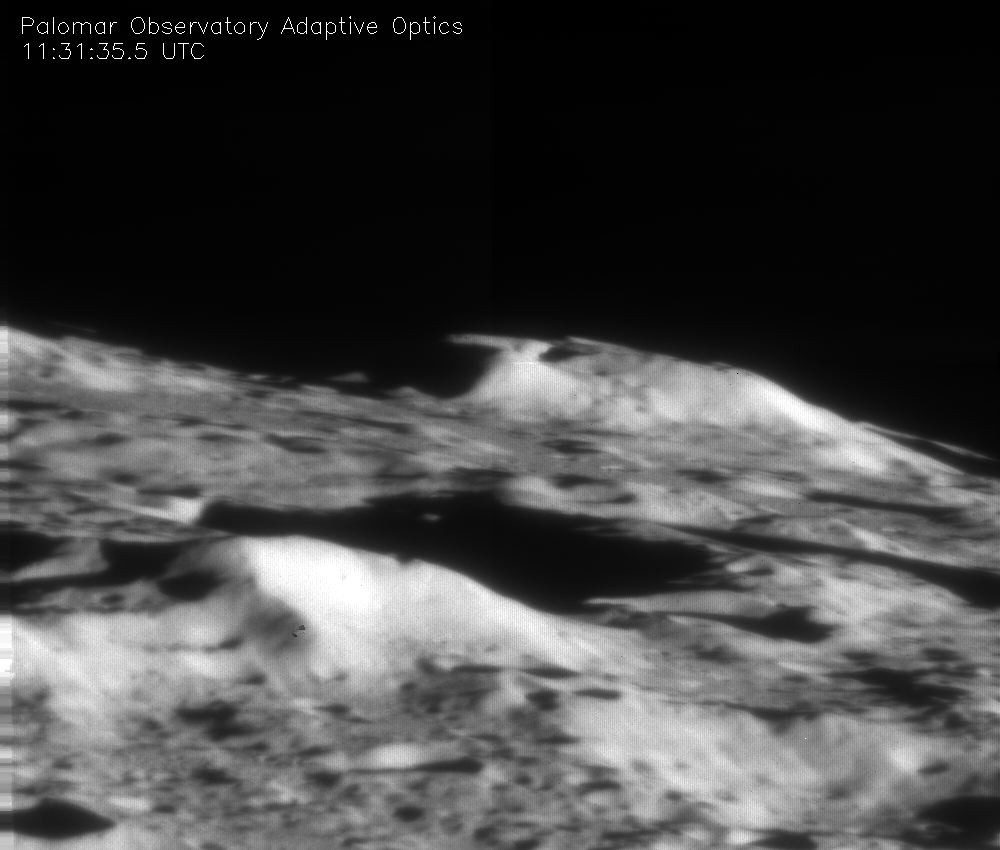
... and 15s after impact. No obvious detection of an impact ejecta plume. Palomar AO movie of the LCROSS impact (19 Mb MPEG)
Contact Information
- Palomar dataroom phone: 760-642-2105
- WebEx telecon starts at 18:30 10/8/09 PDT.
- Participating Observatories (.doc)
Schedule (Times UT, updated 10/6/09)
- ~02:00 Spacecraft separation
- 08:30 Acquire Cabeus crater; determine best feature to use for AO lock
- 10:30 Acquire 1st set of sky background frames
- 11:00 Begin impact imaging sequence
- 11:31:19 Centaur impact
- 11:35:45 Shepherding spacecraft impact
- 11:50 End impact imaging sequence, acquire 2nd set of sky background frames
- 14:00 NASA ARC press conference (submit graphics by 12:30)
Observing Plan
Our goal is to image the evolution of the LCROSS debris plume at the highest possible spatial resolution. We plan to use the Palomar Adaptive Optics system to lock on a bright lunar feature, probably a crater wall or mountain peak, near the predicted impact location. Full AO correction should provide spatial resolution of ~0.1 arcseconds (180 meters at Cabeus crater) across the 40 arcsecond (71 km) field of view of the PHARO near-infrared camera. The debris curtain is expected to expand at ~150 m/s, reaching maximum brightness after ~60s at a diameter of ~20 km. We will acquire 1.4s integrations every 2.8s, thus providing a ~40 frame movie of the expanding debris plume during its highest density phase. We will observe at K band (2.1 microns), to maximize AO correction and sensitivity to large particles. We have allocated 2 hrs (8:30-10:30 UT) to locate Cabeus crater and test surrounding features for that providing the best AO correction. We will then offset to blank sky to acquire bias/background frames, and begin our impact imaging sequence at 11:00 UT. We intend to continue the image sequence through impact and for at least 15 minutes after Centaur impact.Finder Charts
PHARO 40" field overlaid on NASA GSFC visualization as seen from Palomar.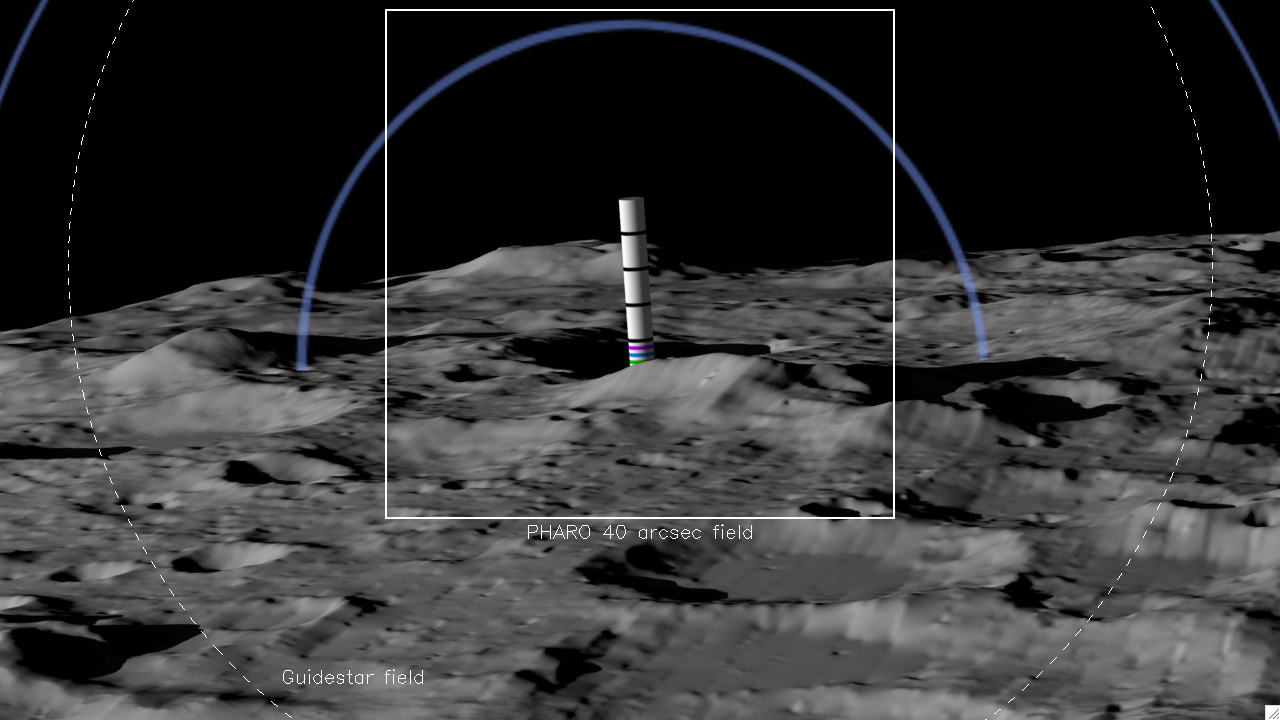
Gemini finder chart
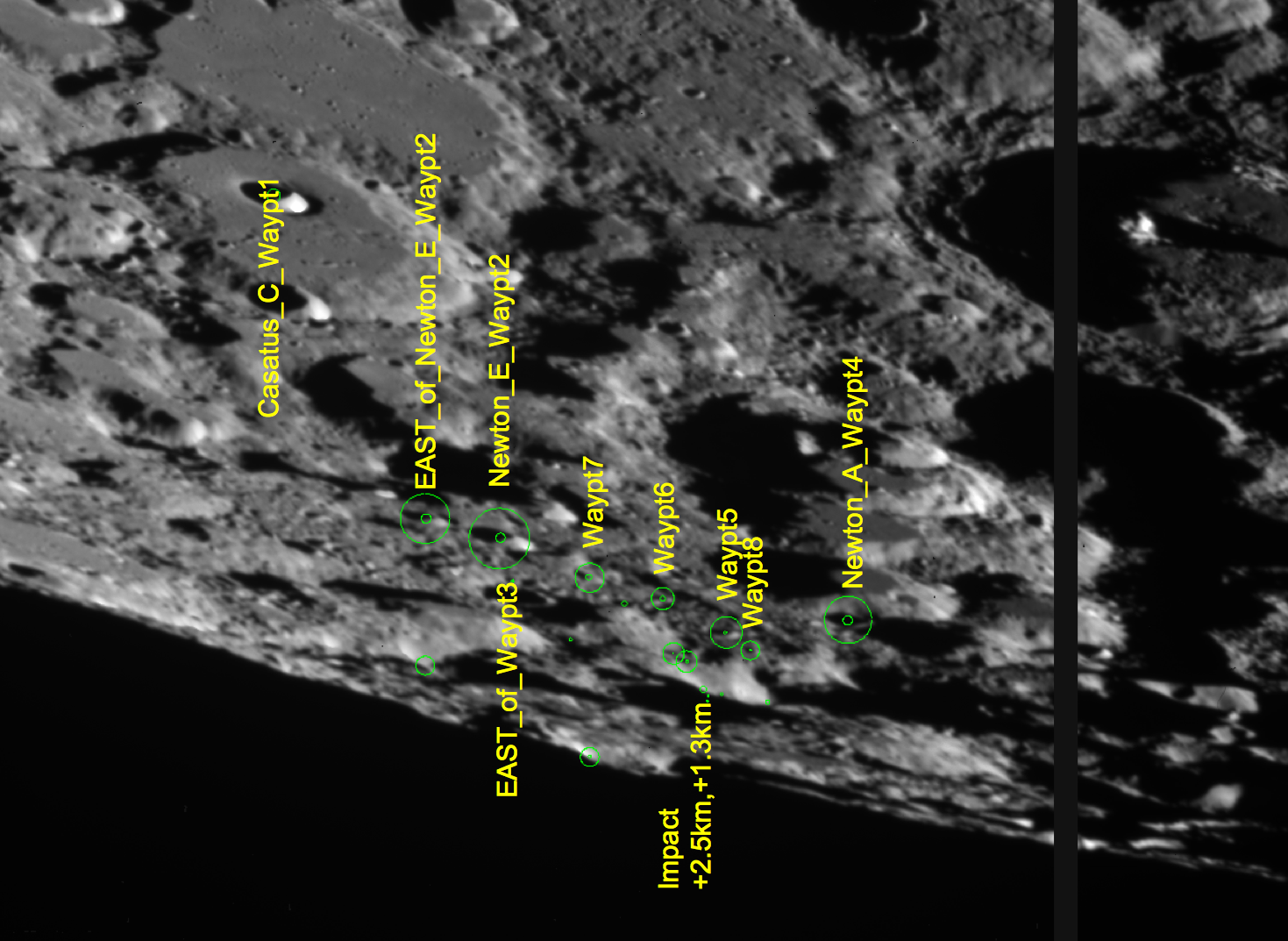
Ephemeris, Timelines, Etc.
- Range to impact site is 3.66936 x 10^5 km.
- cabeus_ephem.txt: Ephemeris for moon lat: 310.95, lon: -84.70, alt:0 km.
Links


| I | Attachment | History | Action | Size | Date | Who | Comment |
|---|---|---|---|---|---|---|---|
 png png |
Gemini_finder_chart.png | r2 r1 | manage | 1027.4 K | 2009-10-08 - 22:01 | UnknownUser | |
 xls xls |
LCROSS_Observation_Campaign_Timeline_6Oct.xls | r1 | manage | 20.5 K | 2009-10-07 - 05:41 | UnknownUser | |
 doc doc |
LCROSS_Observatory_Status_Sheet_6Oct.doc | r1 | manage | 43.5 K | 2009-10-07 - 05:41 | UnknownUser | |
| png |
Palomar_ao_bouchez_10s_after_impact.png | r1 | manage | 318.8 K | 2009-10-09 - 14:52 | UnknownUser | |
| png |
Palomar_ao_bouchez_15s_after_impact.png | r1 | manage | 318.2 K | 2009-10-09 - 14:53 | UnknownUser | |
 txt txt |
cabeus_ephem.txt | r1 | manage | 29.1 K | 2009-10-07 - 00:00 | UnknownUser | |
 mpg mpg |
lcross_palomar.mpg | r1 | manage | 19207.9 K | 2009-10-10 - 07:21 | UnknownUser | |
| png |
pharo_field.png | r1 | manage | 786.5 K | 2009-10-07 - 20:30 | UnknownUser |

Topic revision: r9 - 2009-10-10 - AntoninBouchez


 Site map
 Antarctica web
 More...

 Create New Topic
 Index
Index Search
 Changes
 Notifications
 RSS Feed
 Statistics
 Preferences
 Account




 Copyright © 2008-2025 by the contributing authors. All material on this collaboration platform is the property of the contributing authors.
 Ideas, requests, problems regarding TWiki? Send feedback